

Conviction Doesn’t Beg
On the difference between trying to convince people and actually believing what you’re saying — and why one of them leaks and the other holds.

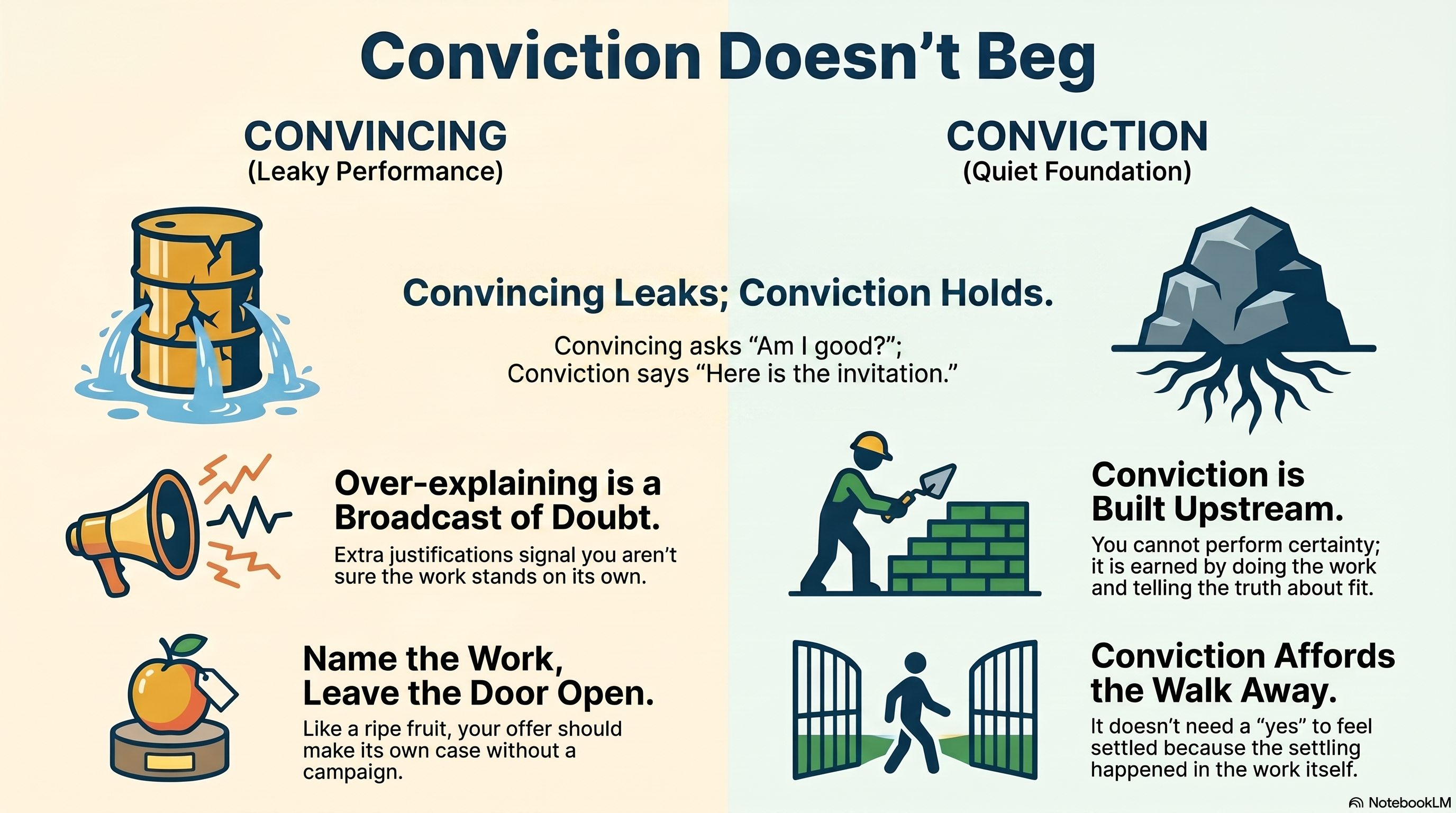
There’s a tell, and once you see it you can’t unsee it. Watch someone make an offer they’re not sure of. The voice climbs. The words multiply. They explain it three different ways, drop the price before anyone asked, add a bonus, add another, and somewhere in there the whole thing tips from offering into pleading. They’re not selling anymore. They’re begging you to make them feel okay about what they’ve built.
That’s convincing. And convincing leaks energy the entire time it’s happening, because underneath every word is a question the person is asking you to answer: Is this good? Am I good? Please tell me yes.
Conviction is the opposite, and it’s quiet. Conviction says: I know what this is, I know who it’s for, here’s the invitation. Then it stops talking. It doesn’t chase. It doesn’t stack adjectives. It doesn’t need your yes to feel settled, because the settling already happened — before the conversation, in the work itself.
Why over-explaining repels the exact person you want
When you over-explain, you think you’re being thorough. You’re actually broadcasting doubt. Every extra justification is a small confession that you’re not sure the thing stands on its own — and people read that instantly, even when they can’t name it. The endless explaining doesn’t reassure them. It does the reverse. It tells them: if this were really solid, she wouldn’t have to work this hard to prove it.
The discerning buyer — the only kind you actually want — moves toward clarity and away from pressure. So the harder you push, the faster the good ones leave, and the only people left in the room are the ones who respond to pressure, which means you’ve spent all that energy filtering for the customers who’ll be the most trouble and out the ones you wanted. Convincing doesn’t just leak energy. It sorts your audience exactly wrong.
Conviction is built upstream
Here’s the thing nobody wants to hear: you cannot perform conviction. You can’t add it in the sales conversation with better phrasing or a steadier voice. It’s not a delivery skill. It’s a foundation, and it gets poured long before anyone shows up to buy.
It’s built when you do the work to the point where you’d recommend it to your own people. It’s built when you get honest about who it’s for and who it isn’t, so you’re never trying to wedge the wrong person into it. It’s built when you’ve actually delivered the thing enough times to know what it does and what it doesn’t. Do that work, and conviction shows up on its own — you won’t have to manufacture a single drop of it. Skip that work, and no amount of confidence-coaching will cover the hollow underneath. The audience hears the hollow.
This is why the question isn’t how do I sound more sure? The question is am I actually sure, and if not, what’s missing? Sometimes the leaky pitch is telling you the truth: the offer isn’t ready, or it isn’t yours, or it doesn’t do what you’ve been claiming. The fix for that is not a better script. It’s going back upstream and pouring the foundation you skipped.
The plant doesn’t argue for the sun
A growing thing makes its case by growing. The tomato doesn’t convince you it’s ripe; it just is, and you can see it, and you reach for it. There’s no campaign. The evidence and the thing are the same object.
That’s what conviction looks like in a person. You become someone whose work is so clearly itself that the right people recognize it and reach for it, and the wrong people pass, and neither outcome rattles you — because you were never asking the room to validate you. You were just naming what you’d grown and leaving the door open.
Build the foundation. Tell the truth about fit. Make the invitation once, cleanly. Then let it stand.
Conviction doesn’t beg. It doesn’t have to. It already knows what it’s worth, and it can afford to let you walk away.
Conviction gets built upstream, in the work. The paid tier is that upstream work, done for you — the frameworks already poured, so you're not manufacturing confidence you haven't earned.
If this was useful, good — it’s built to work on its own. There’s no withheld “real secret” sitting behind a paywall. The recipe’s all here.
The paid tier is for one thing: handing you the work already done. Same thinking, assembled into [the tools / templates / frameworks] so you spend your hours using them instead of building them from scratch. The free pieces are the recipe. Paid is the meal kit. You’re paying for time, not for a result you couldn’t reach yourself.
It’s not for everyone, and I’d rather say so. If you’ve got more time than money right now, stay free and build it yourself — every recipe works. If your time’s worth more than the price,$77/year.
Either way, I’m glad you’re in the forest.