

The LEADS Rule:
Five Boundaries Before You Buy Another Lead

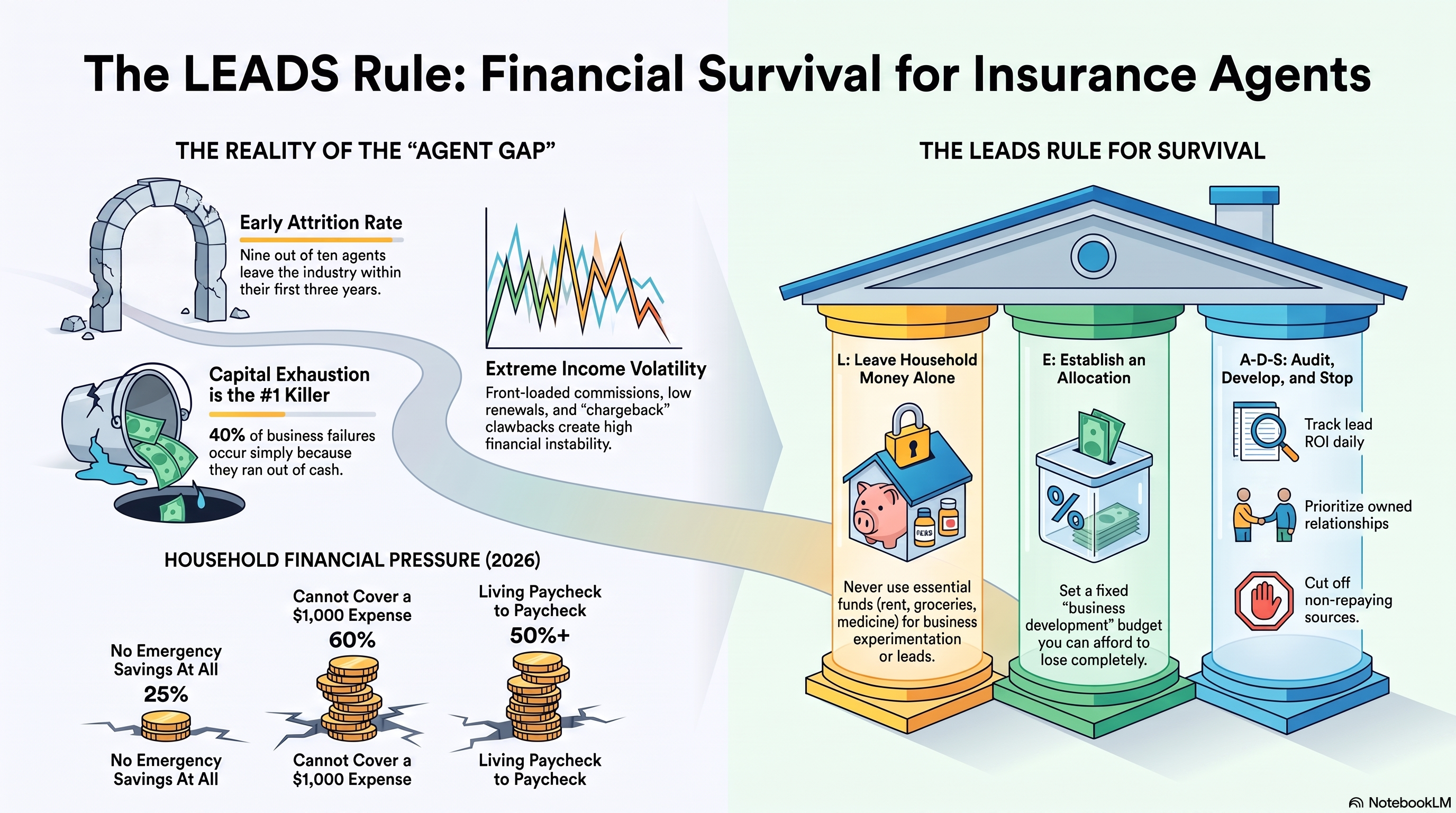
In the last article, I asked you to draw one line: separate your household money from your business money, permanently, before you do anything else in this business. That line matters more than almost anything I’ll teach you in this series, and I want to spend this article showing you exactly why — not with opinion, but with the numbers behind what actually happens to businesses, to commission-based sellers, and to household finances in this country right now.
Once you see the full picture, the LEADS Rule stops looking like caution. It starts looking like the only rational way to build something that survives.
Most Businesses Don’t Fail From Bad Luck. They Fail From Running Out of Money.
Here’s what the data actually says, and it’s more specific than the vague warnings you’ve probably heard.
About one in five new businesses fail within their first year. By the five-year mark, close to half are gone. Those numbers have held remarkably steady across different economic conditions — recessions make the margins worse, but the underlying failure rate stays stubbornly high no matter what the broader economy is doing. That’s an important detail, because it means business failure isn’t primarily something that happens to a business from the outside. It’s something that happens inside a business, from decisions made long before the doors close.
And when researchers actually dig into why businesses fail, the leading cause isn’t what most people assume. It isn’t bad luck, and it isn’t usually a bad product. Running out of capital — simply not having enough cash to survive the gap between spending and earning — is consistently the single biggest killer, cited in roughly four out of every ten failures, with cash flow problems showing up as a contributing factor in a much larger share of closures than that. Insufficient market demand is the second major cause. Team problems and competition trail behind both.
Read that again: the single most common reason a business dies is not that the idea was bad. It’s that the business ran out of money before the idea had time to work.
Now hold that up against what you were told when you started in insurance. You were told the fastest way to build momentum was to spend money — money for leads, money for training, money for whatever the next tool promised to fix your pipeline. Nobody framing that advice ever mentioned that running out of capital is the number one reason businesses like yours don’t make it to year five. The advice to spend aggressively and the data on why businesses fail are pointing in opposite directions, and only one of them has your family’s interests in mind.
Insurance Sales Compounds This Problem, It Doesn’t Escape It
If insurance sales were a stable, salaried profession, the general small-business failure data wouldn’t apply to you directly — you’d just be an employee. But that’s not the structure most agents are working inside. You are, in nearly every practical sense, running a small business, funded by commission, with all the cash-flow fragility that implies, and insurance sales has a few features that make the capital problem worse, not better.
First, commissions are front-loaded and then they fall off a cliff. New agents in life insurance can earn a large percentage of a policy’s first-year premium — sometimes more than the entire annual premium itself — but that rate drops sharply after the first year, often down to one or two percent for renewals, and some products stop paying commission on a policy entirely after a few years. That means an agent’s income in year one looks nothing like their income in year three unless they are constantly writing new business, and a slow month doesn’t just mean less income — it can mean a real cash-flow gap while renewal income is still small and unpredictable.
Second, chargebacks exist. If a policy lapses or gets cancelled early, the commission the agent already earned and often already spent can be clawed back. That’s a feature of very few other sales careers. A software salesperson who closes a deal doesn’t typically have their commission reversed eighteen months later because the customer cancelled. An insurance agent can.
Third — and this is the number that should stop every new agent cold — turnover in this industry is severe. Depending on the source, somewhere close to 90 percent of agents leave the industry within their first three years. That is not a normal attrition rate. That is a business model quietly relying on a constant stream of new recruits to replace the ones who couldn’t make the math work. When an industry loses roughly nine out of every ten people who enter it within three years, the honest question isn’t “what’s wrong with those agents.” It’s “what’s wrong with how those agents were set up to succeed.”
Most new agents in this industry earn somewhere in the neighborhood of $35,000 to $75,000 in their first year, well below what the profession can eventually pay once a book of business and renewal income mature — but “eventually” requires surviving long enough to get there. And “surviving long enough” is precisely the part the industry rarely protects you for, because the standard advice is to spend on leads during the exact period when your income is least stable and your cash reserves are thinnest.
Put the small-business failure data next to the insurance-specific data, and the picture is unambiguous: you are entering a commission structure with unusually sharp income volatility, inside an industry with an unusually brutal early-attrition rate, and the standard advice you’ll be given is to fund your fastest-possible growth with money you may not have a cushion to lose. That is not a formula that favors you. It’s a formula that favors whoever is selling you the leads.
This Is Also Why Commission Selling Can Be the Best Career You Ever Have
I want to be honest about the other side of this, because the LEADS Rule isn’t an argument against commission-based sales. It’s an argument for surviving long enough to let commission-based sales do what it’s actually capable of doing.
There is no ceiling on what a skilled, relationship-driven insurance agent can eventually earn. Unlike a salaried job, your income in this business is not capped by a title or a pay band — it’s capped by the size and health of the relationships you build and maintain. Renewal income, once you’ve survived long enough to build it, becomes a form of earned equity: money that shows up year after year because of relationships you developed once and kept. Very few careers let an ordinary person build something that resembles an owned asset out of nothing but consistent, honest work with people.
That’s the best version of this career. The worst version is what happens to the roughly nine in ten agents who never make it past year three — often not because they lacked the skill to eventually succeed, but because they ran out of runway before their book of business had time to mature. The same career can be the best financial decision of someone’s life or the fastest way to drain a household’s savings, and the difference between those two outcomes usually isn’t talent. It’s whether the agent protected their household long enough to let the compounding start working in their favor.
The Household You’re Protecting Is Already Under More Pressure Than You Might Realize
Here’s the last piece of context, and it’s the piece that makes the LEADS Rule feel less like a personal caution and more like basic financial reality for almost everyone reading this.
More than a quarter of American adults currently have no emergency savings at all — the highest level ever recorded. Roughly six in ten Americans can’t cover an unexpected $1,000 expense out of savings. More than half of U.S. households describe themselves as living paycheck to paycheck, and that isn’t confined to lower earners — a meaningful share of households earning six figures report the same thing, because the pressure comes from the gap between income and fixed expenses, not from income alone. Total household debt in this country has climbed to a record high, and nearly three in ten Americans now carry more credit card debt than they have in emergency savings.
This is the actual financial position most new agents are starting from when a manager tells them to buy another batch of leads. Not a comfortable cushion they can afford to experiment with. A household already close to the edge, being asked to lean further out over it, on the promise that this batch of names will be the one that finally pays for itself.
That is the real backdrop behind the LEADS Rule. It isn’t theoretical. It’s the financial reality most agents are quietly carrying into every “you have to spend money to make money” conversation.
The Five Rules
With that context, here is the boundary, in full.
L — Leave household money alone. Rent or mortgage, groceries, utilities, medication, minimum debt payments, insurance, reliable transportation, childcare — none of it is available for business experimentation, no matter how promising the pitch.
E — Establish a business-development allocation. A separate amount, decided in advance and not in the heat of a sales conversation, that you have determined you can afford to lose completely without touching your household’s stability.
A — Audit every source. Cost per contact, per appointment, per placed policy, net of chargebacks. A lead source is not successful because it produced activity. It’s successful because it produced an acceptable return.
D — Develop owned relationships daily. Every dollar you don’t spend on rented access to strangers is a dollar and an hour you can invest instead in policyholders, referral partners, and employers who already know your name — relationships that don’t carry a per-lead cost or the regulatory documentation burden that now follows purchased leads.
S — Stop funding what does not repay you. Decide your stopping rules before you spend the money, not after you’ve already sunk more into a source than you can justify.
Why This Matters More Than It Might Seem
None of this is about fear. It’s about giving your business — and the people whose lives your business supports — the actual conditions it needs to survive long enough to become what it’s capable of becoming. The data is consistent across every angle: businesses fail primarily from running out of money, insurance sales carries sharper income volatility than most careers, agent attrition in this industry is severe, and most households don’t have the cushion to absorb an aggressive bet gone wrong.
The LEADS Rule exists because of all of that, not in spite of it. Protect the household first. Everything else in this system — the DRIVE Hour, the DRIVE 1000, Earn the DRIVE — is built on the assumption that this boundary is already in place. Build it first, and the rest of this training has something stable to stand on.
Sources & Further Reading
Regulations and statistics in this space change frequently. The figures below reflect the most current publicly available data as of July 2026.
Small Business Survival & Failure Data
Wave Connect — Small Business Statistics 2026 (BLS-sourced failure rates and causes): https://wavecnct.com/blogs/small-business-statistics
Crestmont Capital — Small Business Failure Rate Statistics: The Complete 2026 Data Guide: https://www.crestmontcapital.com/blog/small-business-failure-rate-statistics-2026
Verdikt — Small Business Failure Rate: What the 2026 Data Actually Says: https://getverdikt.com/blog/small-business-failure-rate-what-the-data-actually-says
Insurance Industry Income & Turnover
Insurance Business Magazine — Life Insurance Agent Salary: Everything You Need to Know: https://www.insurancebusinessmag.com/us/guides/life-insurance-agent-salary-everything-you-need-to-know-448558.aspx
Aceable Insurance — What Insurance Agents Actually Earn in Their First Year: https://insurance.aceable.com/resources/pre-license/what-insurance-agents-actually-earn-in-their-first-year/
AgencyBloc — Why 89% of Insurance Agents Quit Within 3 Years: https://www.agencybloc.com/agency-management-system/insurance-agent-management-software/why-89-of-insurance-agents-quit-within-3-years/
Agency Builder Pro — Insurance Agent Recruiting Statistics: https://www.agencybuilderpro.com/insurance-agent-recruiting-statistics
Household Financial Stress
Bankrate — 2026 Emergency Savings Report: https://www.bankrate.com/banking/savings/emergency-savings-report/
Capital Counselor — Personal Finance Statistics 2026: https://capitalcounselor.com/blog/personal-finance-statistics/
Zippia — How Many Americans Live Paycheck to Paycheck? 2026: https://www.zippia.com/advice/how-many-americans-live-paycheck-to-paycheck/