

When Your Sales Aren’t Converting and It’s Pissing You Off
Now, Let's Not Emotion Drive the Train

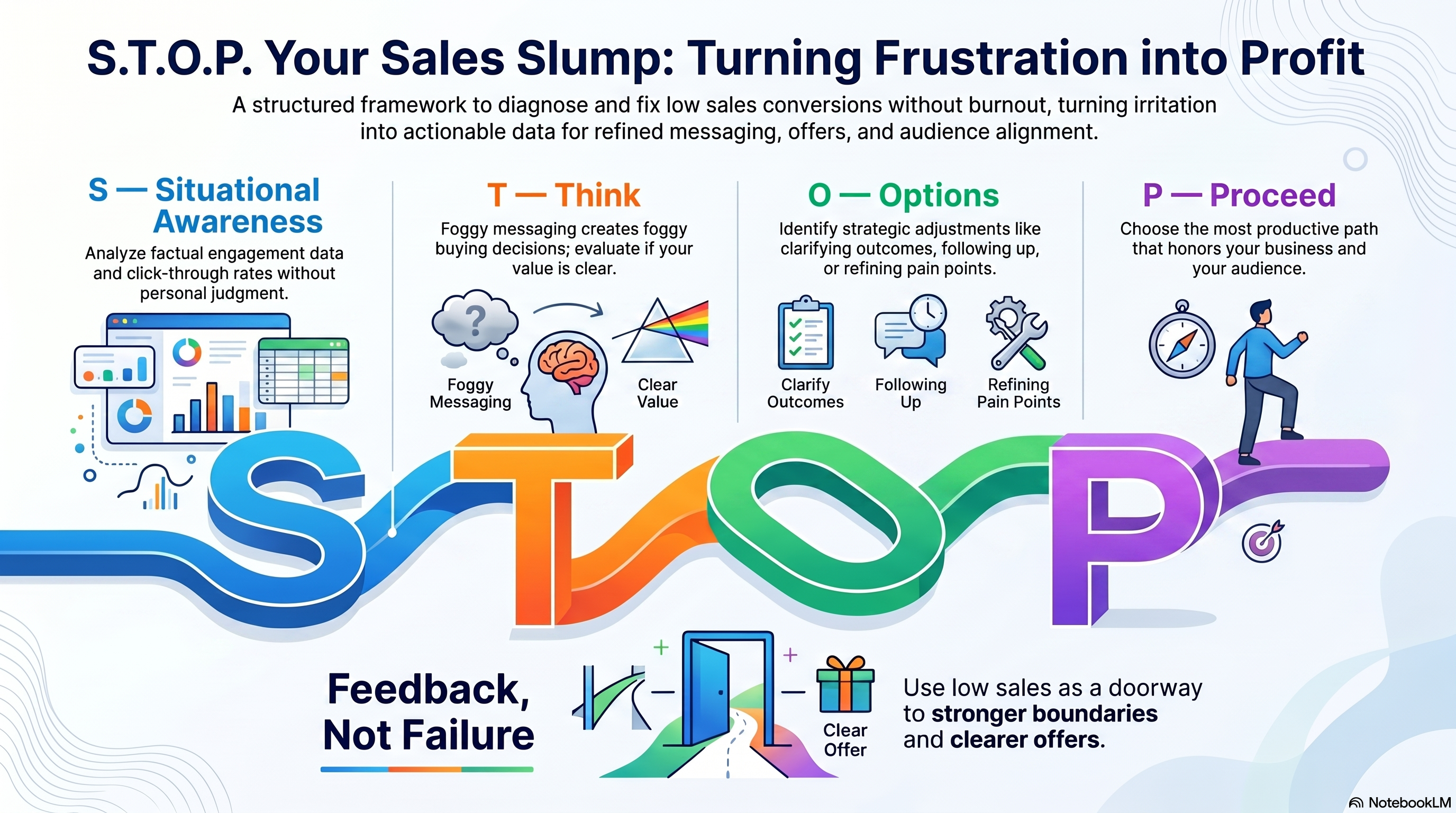
Let’s be honest: when your sales aren’t converting, it can feel personal.
You put the offer out there.
You wrote the post.
You sent the email.
You did the thing.
And then… crickets.
Or worse, people are engaging, asking questions, saying they’re interested, and then disappearing into the witness protection program of “I’ll think about it.”
Cue the emotional wave.
“That pisses me off.”
“Well, maybe it’s not so bad.”
“Okay, maybe they’re just not ready.”
“But seriously… WHY is no one buying?”
If you’re in Human Design land and you’re emotionally defined, you already know the wave is going to wave. And even if you’re not into Human Design, you’ve probably experienced the very human reaction of frustration, disappointment, or irritation when your effort is not turning into income.
But here’s the thing: anger around sales is often information.
It might be telling you something is off in your messaging.
It might be showing you that your audience doesn’t understand the value.
It might be revealing that your offer needs refinement.
Or it might simply be pointing out that you are exhausted, impatient, or trying to force a result before the timing is right.
The key is not to stuff the anger down, spiral into shame, or start yelling into the algorithmic void.
Instead, S.T.O.P.
S — Situational Awareness
Start by looking at the situation without judgment.
Not “I’m bad at sales.”
Not “Nobody wants what I have.”
Not “The internet hates me and my ancestors.”
Just awareness.
What is actually happening?
Are people seeing the offer?
Are they clicking but not buying?
Are they asking questions but not committing?
Are you getting no engagement at all?
Are you making the offer clearly and consistently, or are you whispering it once and hoping the universe sends a parade?
Before you decide your entire business is broken, look at the facts.
T — Think
Now think about the people involved and the decisions that need to be made.
Your potential clients are making decisions too. They are asking themselves:
“Do I need this?”
“Do I trust this person?”
“Do I understand the value?”
“Is this the right time?”
“Can I see myself getting the result?”
At the same time, you need to think about your own input and output.
What are you putting into the sales process?
Is your message clear?
Are you speaking to the problem they actually care about?
Are you explaining the transformation, or just listing features?
Are you making it easy for them to say yes?
Sometimes sales do not convert because the offer is wrong. But sometimes the offer is great and the communication is cloudy.
Foggy messaging creates foggy buying decisions. Tiny business gremlin strikes again.
O — Options
Next, look at your options.
Rewrite the sales page.
Clarify the outcome of the offer.
Talk more directly about the pain point.
Follow up with warm leads.
Ask past clients what made them say yes.
Adjust the price, payment plan, bonus, or timing.
You could stop selling to people who are not aligned and focus on the ones who are.
The point is not to panic-change everything because you had one bad sales day. The point is to ask:
What are my real options here?
What might create the result I actually want?
What are the rewards and consequences of each choice?
Do not let frustration make the decision for you. Frustration is allowed in the meeting, but it does not get to be the CEO.
The great thing about frustration is that it makes you aware something is not working to your satisfaction and that can give you momentum to find out how to fix it. So don’t silence it, use it….
CONSTRUCTIVELY.
P — Proceed
Then proceed with the most productive, peaceful, and prosperous option.
Not the people-pleasing option.
Not the “burn it all down and start a goat farm” option. (Did that once. Not a great outcome.)
Not the “discount it until I resent everyone” option.
Choose the next step that honors you, respects your audience, and supports the business you are actually building.
That might mean refining your message.
That might mean getting more visible.
That might mean following up.
That might mean giving the offer more time.
That might mean admitting that the offer needs work.
The goal is not to avoid anger. The goal is to use it as a signal instead of letting it drive the car.
Because when your sales are not converting, anger can make you assume the worst. It can push you into frantic posting, awkward discounting, blaming your audience, or deciding you are “just not good at sales.”
But when you S.T.O.P., you create space.
Space to see what is actually happening.
Space to understand what your buyers need.
Space to explore your options.
Space to proceed in a way that is clear, grounded, and aligned.
Sometimes low sales are not a sign that you should quit. Sometimes they are simply feedback.
And feedback, while occasionally annoying and wearing ugly shoes, can be incredibly useful.
So the next time your sales are not converting and it is pissing you off, take a breath and S.T.O.P.
Your anger may not be the problem.
It might be the doorway to better messaging, stronger boundaries, clearer offers, and more aligned sales.
Because yes, the wave is going to wave.
But you still get to choose how you surf it.
And if you liked that I made you laugh during a crisis of low converting sales….
There’s more where that came from so….